
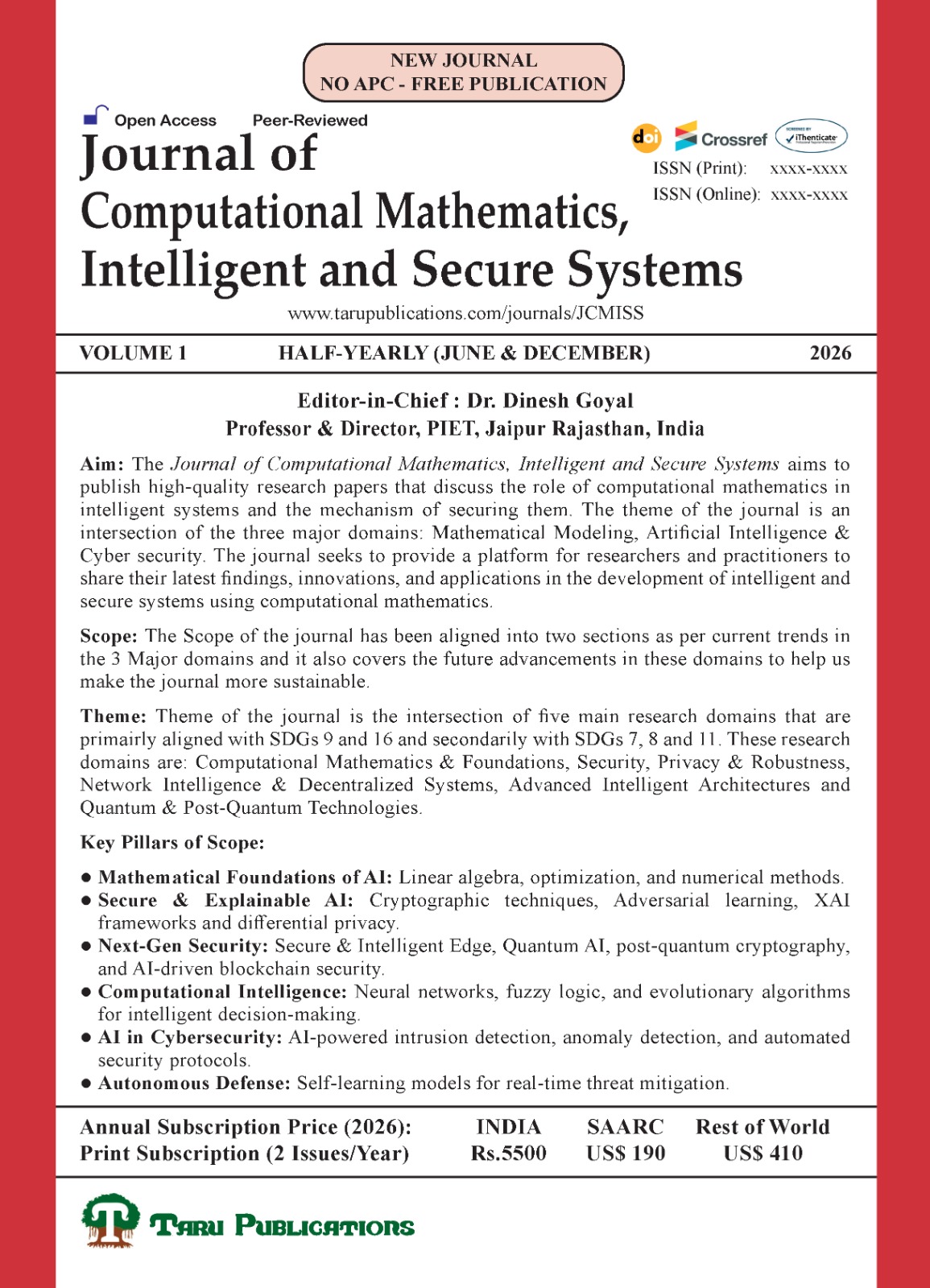

Aims & Scope
The journal publishes high-quality original research, review articles, and interdisciplinary studies that advance the mathematical foundations, theoretical developments, and practical applications of Artificial Intelligence, Machine Learning, Data Science, Cybersecurity, and Emerging Computing Technologies. It aims to provide an international platform for researchers, academicians, industry experts, and practitioners to disseminate innovative research addressing current and future challenges in intelligent systems and computational sciences.
The journal welcomes submissions in, but is not limited to, the following areas:
Numerical and Linear Algebra:
Tensor decompositions
High-dimensional data analysis
Numerical stability in deep learning
Optimization Theory
Non-convex optimization
Stochastic Gradient Descent (SGD) variants
Evolutionary algorithms for neural architecture search
Dynamical Systems and Calculus
Differential equations for Neural Ordinary Differential Equations (Neural ODEs)
Network fluid dynamics
System stability analysis
Probabilistic and Statistical Modeling
Bayesian inference and Markov Foundations
Computational Uncertainty Quantification (UQ)
Time-series predictive modeling
Neural Network Architectures
Transformer models
Graph Neural Networks (GNNs)
Message-passing algorithms for large-scale networks
Neuro-Symbolic Artificial Intelligence
Integration of deep learning with symbolic reasoning
Knowledge representation
Formal verification and trustworthy AI
Explainable Artificial Intelligence (XAI)
Mathematical Frameworks (SHAP, LIME)
Taylor expansion-based interpretability
Transparent and explainable machine learning
Autonomous and Intelligent Systems
Reinforcement learning
Self-learning models for Robotic autonomy
Autonomous decision-making
Green Artificial Intelligence Mathematics
Energy-efficient optimized AI algorithms
Green AI & Computational optimization
Sustainable Large Language Models (LLMs)
Adversarial Machine Learning
Adversarial robustness
Poisoning and evasion attacks
GAN-based defense mechanisms
Intelligent Cybersecurity
AI-Driven Adaptive intrusion Detection Systems
Zero-Day Exploit Identification & Predictive Threat Intelligence
Scalable Intrusion Prevention over High Speed Networks
Privacy-Preserving Machine Learning
Federated learning
Differential privacy
Secure learning on encrypted data
Advanced Cryptography
Homomorphic encryption
Secure Multi-Party Computation (SMPC)
Zero-Knowledge Proofs (ZKPs)
Game Theory and Cyber Defense
Stackelberg games
Strategic attacker-defender modeling
Security optimization
Biometrics and Digital Identity
AI-based biometric authentication
Identity verification & Validation
Zero Trust security frameworks
Graph Theory and Topological Data Analysis
Spectral graph theory for Community detection
Topological Data Analysis (TDA)
Malware detection and analysis
Blockchain and Web3 Security
AI-enhanced Smart contract auditing
Formal verification of Decentralized system security
Consensus algorithms
Edge Computing and Distributed Intelligence
Lightweight AI models
Intelligent Resource-constrained computing
AI-enhanced Software-Defined Networking (SDN)
Security Digital Twins
Mathematical modeling
Infrastructure security simulation
Financial fraud detection
Quantum Artificial Intelligence
Quantum machine learning
Quantum optimization
Hybrid quantum-classical computing
Post-Quantum Cryptography
Mathematical Models for Lattice-based cryptography
Mathematical Models for Code-based cryptography
Mathematical Models for Multivariate cryptographic algorithms
Quantum Security Protocols
Quantum Key Distribution (QKD)
Quantum-resistant digital signatures
Secure quantum communication
The journal encourages interdisciplinary research that bridges mathematics, artificial intelligence, cybersecurity, data science, and emerging computational technologies, promoting innovative theoretical contributions as well as practical applications with significant scientific and societal impact.
