
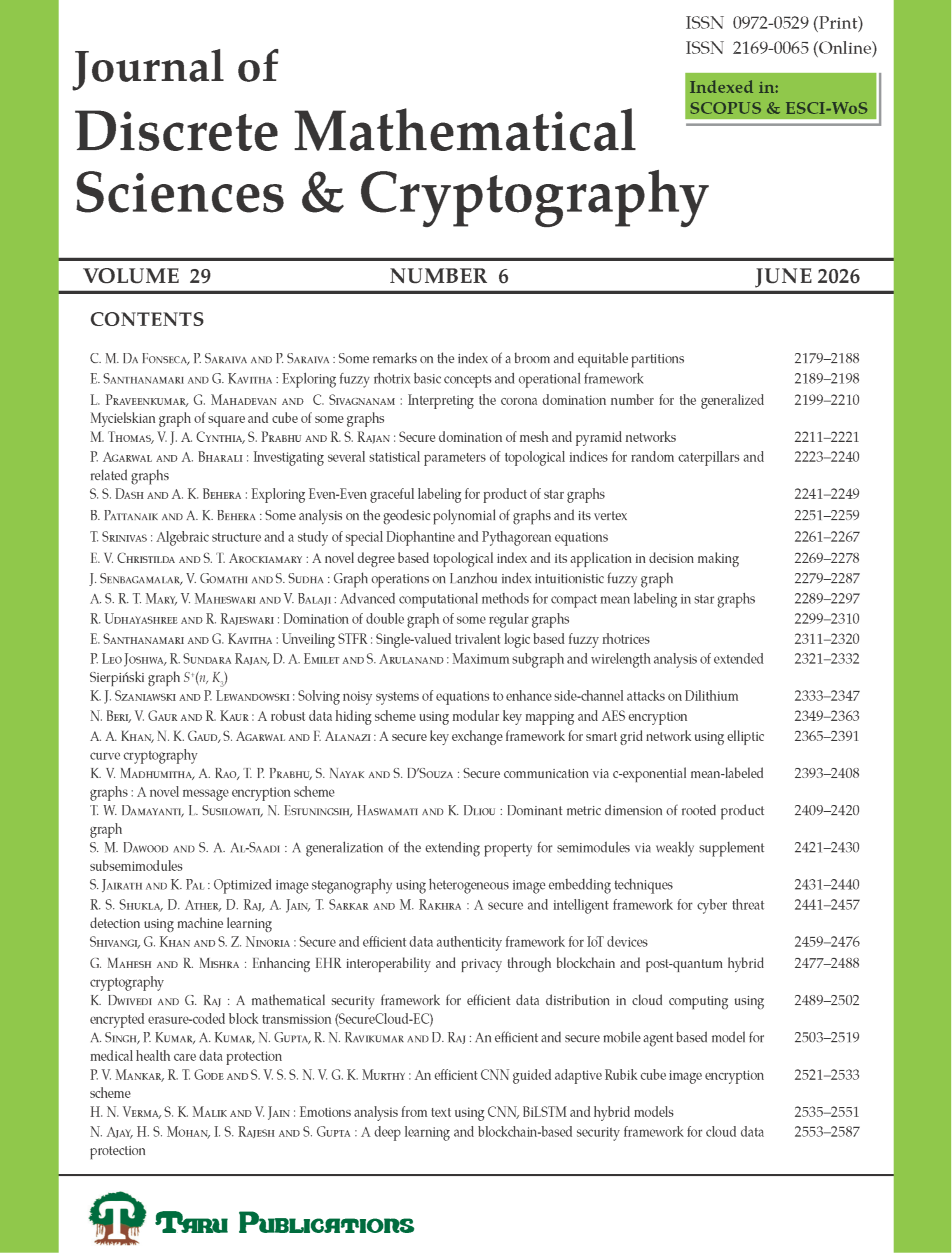


Secure and scalable data aggregation techniques for healthcare monitoring in WSN
Mahendra Alatemahendra.alate@gmail.comKrishna Institute of Medical Sciences Krishna Vishwa Vidyapeeth (Deemed to be University)Karad, Maharashtra, 415539, IndiaView full profile → , Uma R. Godaseurgodase@gmail.comSchool of Computing MIT Art, Design and Technology UniversityPune, Maharashtra, IndiaView full profile → , Uddhav T. Kumbharutkumbhar@gmail.comDepartment of Community Medicine, Krishna Institute of Medical Sciences Krishna Vishwa Vidyapeeth (Deemed To Be University)Karad, Maharashtra, IndiaView full profile → , *Sheela HundekariCorresponding authorsheelahundekari90@gmail.comDepartment of MCA MIT-COM MIT Art, Design & Technology University Loni KalbhorSchool of Computer Applications Pimpri Chinchwad UniversityPune, Maharashtra, 412106, IndiaView full profile → , Araddhana Arvind Deshmukhaadeshmukhskn@gmail.comDepartment of Computer Science & Information Technology (Cyber Security) Symbiosis Skill and Professional University, KiwaleDepartment of Computer Science & Information Technology (Cyber Security) Symbiosis Skill and Professional UniversityPune, Maharashtra, 412101, IndiaView full profile → , Anil Kumaranilkumar@poornima.orgDepartment of Computer Science and Engineering Poornima Institute of Engineering & TechnologyDepartment of Computer Engineering Poornima Institute of Engineering & TechnologyJaipur, Rajasthan, 302022, IndiaView full profile →
* Corresponding author · click or hover a name for details
- Published Online:
- 06 Apr 2024
- Article type:
- Research Article
- Language:
- EN
- Article no.:
- JDMSC-1900
- Pages:
- 441–452
Abstract
Keywords
Subject Classifications
References
[1] E. R. P. and D. S. Misbha, “Lightweight key distribution for secured and energy efficient communication in wireless sensor network: An optimization assisted model,” High-Confidence Comput., vol. 3, no. 2, p. 100126 (2023), doi: 10.1016/j.hcc.2023.100126.
[2] A. B. Feroz Khan and G. Anandharaj, “A cognitive key management technique for energy efficiency and scalability in securing the sensor nodes in the IoT environment: CKMT,” SN Appl. Sci., vol. 1, no. 12, pp. 1–7 (2019), doi: 10.1007/s42452-019-1628-4.
[3] Sharma, Sandeep Kumar, Kumar, Anil, Ashtagi, Rashmi & Jain, Rekha. OCA: An intelligent model for improving security breach of biometric based authentication systems, Journal of Discrete Mathematical Sciences and Cryptography, 26:5, 1415–1425 (2023), DOI: 10.47974/JDMSC-1765.
[4] L. Kaur and R. Kaur, “A survey on energy efficient routing techniques in WSNs focusing IoT applications and enhancing fog computing paradigm,” Glob. Transitions Proc., vol. 2, no. 2, pp. 520–529 (2021), doi: 10.1016/j.gltp.2021.08.001.
[5] B. S. Kim and J. S. Song, “Pseudonymous mobile node reauthentication scheme for mobile wireless sensor networks,” ACM Int. Conf. Proceeding Ser., pp. 294–299 (2019), doi: 10.1145/3377170.3377207.
[6] G. Mehmood et al., “An Efficient and Secure Session Key Management Scheme in Wireless Sensor Network,” Complexity, vol. 2021 (2021), doi: 10.1155/2021/6577492.
[7] C. Nakas, D. Kandris, and G. Visvardis, “Energy efficient routing in wireless sensor networks: A comprehensive survey,” Algorithms, vol. 13, no. 3, pp. 1–65 (2020), doi: 10.3390/a13030072.
[8] A. S. H. Abdul-Qawy et al., “An enhanced energy efficient protocol for large-scale IoT-based heterogeneous WSNs,” Sci. African, vol. 21, no. April, p. e01807 (2023), doi: 10.1016/j.sciaf.2023.e01807.
[9] J. A. I. Syed Masood, M. Jeyaselvi, N. Senthamarai, S. Koteswari, M. Sathya, and N. S. K. Chakravarthy, “Privacy preservation in wireless sensor network using energy efficient multipath routing for healthcare data,” Meas. Sensors, vol. 29, no. April, p. 100867 (2023), doi: 10.1016/j.measen.2023.100867.
[10] B. A. Begum and S. V. Nandury, “Data aggregation protocols for WSN and IoT applications – A comprehensive survey,” J. King Saud Univ. - Comput. Inf. Sci., vol. 35, no. 2, pp. 651–681 (2023), doi: 10.1016/j.jksuci.2023.01.008.
[11] Anil Kumar & Sandeep Kumar Sharma. Information cryptography using cellular automata and digital image processing, Journal of Discrete Mathematical Sciences and Cryptography, 25:4, 1105-1111 (2022), DOI: 10.1080/09720529.2022.2072437.
[12] D. P. Singh and R. H. Goudar, “Energy efficient clearance routing in WSN,” Int. J. Syst. Assur. Eng. Manag., vol. 8, no. s2, pp. 555–575 (2017), doi: 10.1007/s13198-014-0263-0.
[13] M. Krishnapriya, G. Angeline Prasanna, and S. Anbarasu, “Rank-Based Energy-Efficient Key Management Routing For Wireless Sensor Network-Based Iot Medical Sensors,” Wirel. Pers. Commun., vol. 130, no. 3, pp. 2175–2196 (2023), doi: 10.1007/s11277-023-10377-5.
[14] V. Reddy and P. Gayathri, “Energy efficient data transmission in WSN thru compressive slender penetrative etiquette,” J. Ambient Intell. Humaniz. Comput., vol. 11, no. 11, pp. 4681–4693 (2020), doi: 10.1007/s12652-020-01724-6.
[15] M. Shafiq, H. Ashraf, A. Ullah, and S. Tahira, “Systematic Literature Review on Energy Efficient Routing Schemes in WSN – A Survey,” Mob. Networks Appl., vol. 25, no. 3, pp. 882–895 (2020), doi: 10.1007/s11036-020-01523-5.
[16] B. Sureshand and S. G, “An ENERGY EFFICIENT SECURE routing Scheme using LEACH protocol IN WSNS for IOT networks,” Meas. Sensors, vol. 30, no. February, p. 100883 (2023), doi: 10.1016/j.measen.2023.100883.
